
CALL FOR PAPERS Nº22, December 2027, "Ethics, aesthetics and transcendence in world literature"
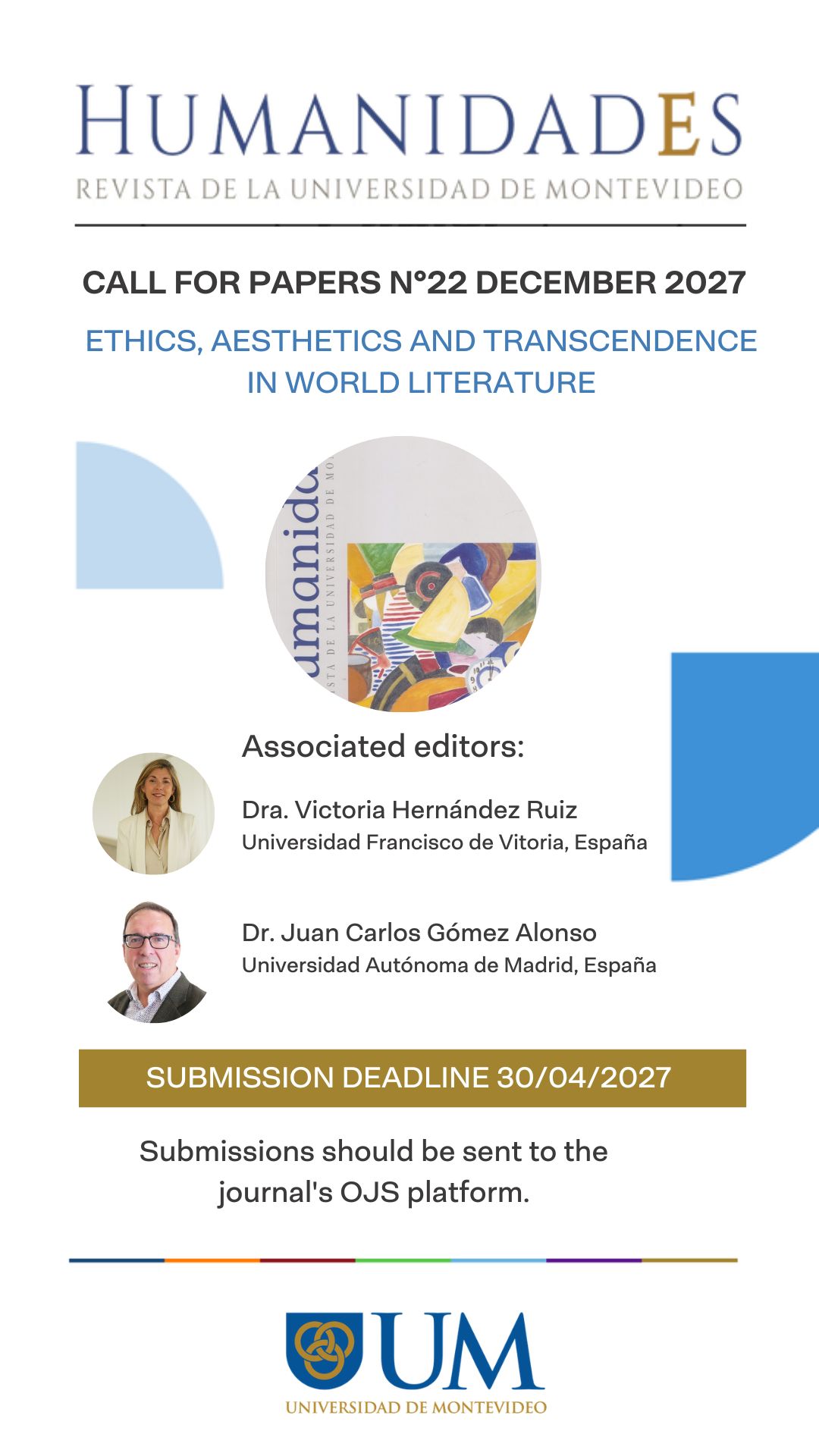
Call for papers for the ‘Studies’ section of issue 22 (December 2027)
Monograph:
Ethics, aesthetics and transcendence in world literatura
Associate editors for this issue:
Dra. Victoria Hernández Ruiz, Universidad Francisco de Vitoria, España victoria.hernandez@ufv.es
Dr. Juan Carlos Gómez Alonso, Universidad Autónoma de Madrid, España juanc.gomezalonso@uam.es
In a cultural context marked by fragmented discourse and the loss of symbolic references, literature remains a privileged space where words question value, beauty and transcendence. It therefore seems pertinent to explore the ethical, aesthetic and transcendent structures in world literature, understood as fundamental dimensions that shape the profound meaning of works and their value in human experience.
However, any approach to the subject also requires a critical review of the very notion of world literature. Since Johann Wolfgang von Goethe coined the term Weltliteratur, its scope has been the subject of intense debate in comparative studies: is it a normative canon, a network of transnational circulations, or a heuristic horizon that allows us to think about works beyond their local contexts? For this reason, we consider literature from an international perspective that is realised in different languages and cultures as concretisations of universal or world literature.
Authors such as Antonio García Berrio (1988, 1994) are supporters of aesthetic universalism, universal human aspects that manifest themselves in literary art. He starts from the idea, inspired by Humboldt, of an inner form of language that constitutes part of the human spirit, to deduce a universal system not only of rhetorical forms, but also of symbolic-expressive structures that allow different peoples in different eras to have artistic forms with a common substrate. Similarly, he addresses how literary text can be analysed from a universal point of view, broadening the theoretical horizon, as he understands that the discipline of literary theory must be able to account for both the singular and the universal, without losing sight of the historical thinking of traditional or classicist poetics that connects with modern poetic linguistics.
Based on this problematisation, exploring the ethical, aesthetic and transcendent structures in universal literature involves examining not only the formal features and anthropological constants present in the works, but also, from an interdisciplinary perspective, how literary works have articulated man's attitude towards the good, the beautiful and the true, offering responses —or resistance— in accordance with the worldview prevailing throughout human history.
Research may remain faithful to the enduring notions set out in Aristotle's Poetics, recognising in concepts such as mimesis of action, fable, structure, catharsis, or recognition, principles that—from their claim to universality—continue to illuminate literary creation and interpretation. This classical horizon will keep alive the dialogue with contemporary theories of possible poetic worlds developed by authors such as Tolkien, Pavel, Eco, Albaladejo, Rodríguez Pequeño, Ryan, and García-Noblejas, whose critical reception allows us to reconsider the category of universality from the perspective of world structures and symbolic sub-creations. This approach will allow us to analyse works as architectures of meaning where the ethical, the aesthetic and the transcendent are intertwined with the configuration of poetic cosmologies, recognising both the persistence and the historicity of these categories.
The aim is to conduct a study of works of ancient and medieval literature, including Greek, Latin, biblical and early European vernacular traditions, as well as their multiple projections in cultural history. Likewise, studies on later works that revisit, transform or dialogue with classical and medieval models will be considered, whether from a symbolic re-reading, aesthetic reworking or philosophical resonance.
With the study on Ethics, Aesthetics and Transcendence in Universal Literature, we aim to foster a dialogue between tradition and modernity, focusing on the renewal of poetic languages and promoting convergence between literary criticism, philosophy, theology, philology and aesthetics. The articles will present an interpretative approach capable of connecting literary thought with current cultural challenges: how literary works have articulated man's attitude towards the good, the beautiful and the true, offering responses —or resistance— in accordance with the worldview prevailing throughout human history.
Main themes:
Ethics and narrative. Representations of good, evil, virtue, guilt, justice and forgiveness. The ethical configuration of the hero and the moral dimension of the story from Antiquity to modernity. Literature as an interrogation of the human condition.
Aesthetics and language. Textual, poetic and rhetorical strategies that embody universal aesthetic values. Evolution in stylistic sensibilities. Symbolism and allegory as aesthetic resources. Autobiographies, hagiographies and documents of the self. Aesthetics of horror and aesthetics of the sublime in literary narratives.
Transcendence and symbolism. The spiritual, metaphysical or mystical dimension of works, from the Greco-Roman, biblical and medieval classics to modern and contemporary literature. Literature as revelation. The journey as allegory and metaphorical engine. The transcendence of long sellers.
Poetics and possible worlds. Analysis of literary works—ancient, medieval, or later—as architectures of meaning and configurations of possible worlds. Study of poetic cosmologies, categories of transcendence, symbolic construction of moral and metaphysical order, and models of representation of the invisible or supernatural. Dialogue between poetics, metaphysics, philosophy of language, and narrative aesthetics.
Tradition, reception and rewriting. Transformation of classical and medieval models in ethical, aesthetic or transcendental terms in modern and contemporary literature. Symbolic reinterpretations, formal reworkings, mythical or biblical rewritings, philosophical appropriations and intertextual resonances that demonstrate the continuity and metamorphosis of ancient imaginaries in diverse cultural contexts.
Critical review of the notion of universal literature. Comparative debates and contemporary theoretical models. Discussion on canon, circulation and aesthetic universalism. Tensions between the common and the particular in various traditions. Theoretical contributions from Goethe to García Berrio.
Keywords: ethics and aesthetics, transcendence, universal literature, ancient and medieval literature, Aristotle's Poetics, possible worlds, interdisciplinarity.
The deadline for submission of papers is 30 April 2027.
Texts may be submitted in Spanish, English, and Portuguese.
Contributions must adhere to the journal's editorial guidelines: http://revistas.um.edu.uy/index.php/revistahumanidades/about/submissions
Papers should be submitted to the journal's OJS platform.
Humanidades: revista de la Universidad de Montevideo is a peer-reviewed, open access, indexed, scientific journal. It publishes articles on Philosophy, History, Literature and Art and accepts scientific contributions in Spanish, English, French and Portuguese from specialists from various national and international centres. It is published as a continuous publication every six months (January-June and July-December). Under this modality, the texts are published immediately after their approval and layout. Its aim is to constitute an open forum in which the disciplines dialogue with each other and contribute new knowledge. The journal is indexed in: ERIHPLUS, Dialnet, DOAJ, EBSCO-Academic Search Ultimate, Latindex, Scielo, Scopus, among others.




















 This work is under a